Fact-checked · , including U.S. Department of Agriculture, U.S. Bureau of Labor Statistics
Credit: Shutterstock
Key Takeaways
•Normalized to 25 grams of protein, home-roasted chicken breast costs about $1.03 at the national average price against roughly $2.46 for packaged deli turkey — a real gap, but an ordinary one.
•The same normalization puts sodium at roughly 60 milligrams for home-cooked chicken and between 818 and 1,472 milligrams for the deli products examined, a spread of roughly fourteen to twenty-five times.
•Deli meat is not one category. Across three named products, sodium per 25 grams of protein varied by about 80 percent, which means the choice within the deli case may matter more than the choice to visit it.
Most people think the sandwich decision is a trade between convenience and effort. Deli meat is fast and costs more. Cooking your own is slower and costs less. That framing is not wrong, exactly. It is just aimed at the smaller of the two differences.
I did not start batch-cooking chicken to save money. I started because our weekday lunches were inconsistent, and a container of shredded chicken in the refrigerator made them consistent. The cost advantage was something I noticed later, almost by accident, when I sat down and actually ran the numbers. What I found in the process was that the money gap was smaller than I expected, and something else was much, much larger.
This article is the arithmetic. It uses one comparison unit — cost per 25 grams of protein — and applies it identically to bulk chicken breast and to three named, currently sold deli products. It shows the formula, the assumptions, and the places where the answer changes. It is not a promise about anyone's grocery bill or anyone's health. It is a method, and the point of a method is that you can run it yourself and get your own answer.
Why I Started Batch-Cooking Chicken for the Week
Credit: Daily Vitality
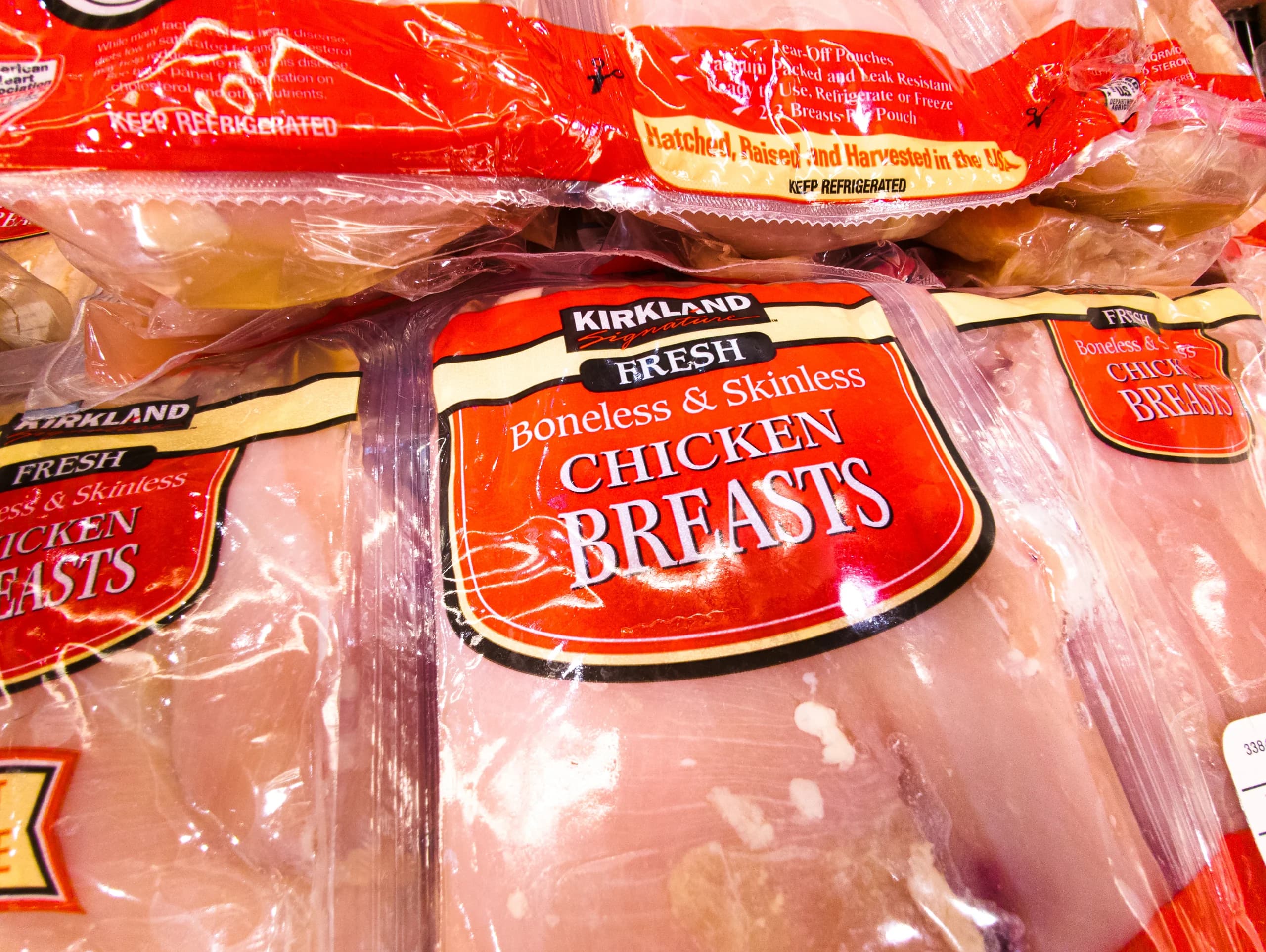
The routine is unremarkable, which is rather the point. Our household buys boneless, skinless chicken breast in bulk at Costco — packs of eight to ten breasts, usually landing somewhere between thirty and thirty-five dollars depending on the weight of the pack. It goes into the Instant Pot. It comes out, cools for a while, and gets shredded with two forks.
That is the entire process. It takes one evening's attention, most of which is not attention at all but waiting.
What it produces is most of a week of lunches. Sandwiches and wraps, mostly, but also tacos and rice bowls when we want the same protein to stop tasting like the same meal. On a normal weekday I will take a chicken wrap instead of a lunch meat sandwich, which is the swap this whole article exists to interrogate.
Before this became a habit, lunches were a mixed bag. Sometimes lunch meat. Sometimes whatever was in the refrigerator. The change was not driven by a budget spreadsheet or a health scare. It was driven by wanting the answer to "what is lunch" to already exist by the time the question came up.
One important boundary before the numbers begin. That Costco pack is Canadian, bought in Canadian dollars, and it is the origin of this story rather than evidence for anything. Canadian warehouse pricing tells a United States reader nothing useful about a United States grocery bill, and converting it would manufacture a precision that does not exist. Every price in the comparison that follows is a current, traceable United States figure. The anecdote is the reason for the question. It is not the answer.
The Question Behind the Math
The question is narrow on purpose: for a weekday sandwich, what does it actually cost to get a meaningful amount of protein from batch-cooked chicken versus from deli meat, and what else comes along with it?
Protein is the reason either product is in the sandwich, so protein is the right denominator. Twenty-five grams is a useful unit because it is roughly what a single sandwich's worth of filling delivers, and because it is close to what one ordinary portion of cooked chicken breast provides. Comparing per serving, which is how nearly every published comparison does it, quietly rewards whichever product contains the least protein per ounce. Comparing per gram of protein removes that thumb from the scale.
Sodium earns its place in the comparison for a reason that has nothing to do with editorial preference. In its consumer guidance on reading nutrition labels, the Food and Drug Administration lists deli meat sandwiches first among the foods that together supply about 40 percent of the sodium Americans consume, ahead of pizza, soups, and savory snacks. The specific food at the center of this comparison sits at the top of the federal government's own list.
The third element is the ingredient label, which is where the two products stop resembling each other at all. One is chicken. The other is chicken or turkey plus a short list of functional ingredients that exist to hold moisture, extend shelf life, and stabilize color.
For readers working through how protein distribution across the day interacts with totals, our examination of protein timing versus protein total covers ground this piece deliberately leaves alone.
How the Comparison Works
The formula has four inputs and no hidden steps.
Purchase price, as paid, for a stated package at a stated place on a stated date.
Usable yield, meaning the edible weight that actually results from that purchase.
Protein density of the food in the form it is eaten, not the form it is bought.
Total protein, which is yield multiplied by density, and from which cost per 25 grams follows directly.
The step that almost every published comparison skips is the second one. Raw chicken is priced per pound of raw chicken, but nobody eats raw chicken. Water leaves during cooking, and the pound you paid for is not the pound you eat.
That loss is substantial. Boneless, skinless chicken breast retains roughly 72 percent of its raw weight once cooked, meaning something close to a quarter of the purchase weight disappears before it reaches a sandwich. The figure can be derived directly from composition data rather than taken on faith: raw breast meat runs between 21 and 22.5 grams of protein per 100 grams, while roasted breast meat runs 31 grams per 100 grams. Because protein is largely retained through cooking while water is not, the ratio between those two densities is the yield. The Agricultural Research Service publishes tables covering the same measurements for specific cuts and cooking protocols.
For the cooked figures themselves, this analysis uses the United States Department of Agriculture FoodData Central entry for roasted chicken breast, meat only, record 171477, which gives 165 calories, 31 grams of protein, and 74 milligrams of sodium per 100 grams.
Deli products need no yield adjustment. They are sold ready to eat, so package weight and edible weight are the same number, and their nutrition panels already describe the food in the form it is consumed. This is a genuine structural advantage for deli meat in any cost comparison, and it is worth naming plainly rather than burying.
Note
The 72 percent yield figure is an assumption, not a constant. Cooking method, final internal temperature, and how long the meat rests all move it. A reader who measures their own cooked weight against their own raw weight will get a more accurate number than this article can supply, and the formula accepts that number without any other change.
Batch-Cooked Chicken: The Cost-Per-Protein Calculation
The price input needs to be reproducible, which rules out any single store's shelf tag on any single afternoon. The Bureau of Labor Statistics publishes a monthly average retail price for boneless chicken breast as a United States city average, which for July 2026 stood at $4.153 per pound and had held within about three cents of that level since March.
From there the arithmetic is short. One raw pound is 453.6 grams. At 72 percent yield, that becomes roughly 327 grams of cooked chicken. At 31 grams of protein per 100 grams, that cooked weight carries about 101 grams of protein.
So one pound of raw chicken breast, bought at the national average price, delivers roughly 101 grams of protein for $4.15. That works out to about $1.03 per 25 grams of protein.
The sodium side of the same portion is where the number starts to look unusual. A three-ounce portion of roasted chicken breast supplies 25 grams of protein alongside 60 milligrams of sodium, according to the Food Safety and Inspection Service nutrition tables. That is 2 percent of a day's Daily Value. It is worth pausing on the coincidence that makes this comparison easy: the government's standard three-ounce chicken portion and this article's 25-gram protein unit are very nearly the same thing.
Warehouse-club pricing changes the cost figure considerably without touching the sodium figure at all. Member's Mark boneless, skinless chicken breast is listed at $2.48 per pound at Sam's Club, roughly 40 percent below the national retail average, which brings the same 25 grams of protein down to about $0.61. Costco's United States warehouse pricing sits behind a member login and could not be captured to the same standard, so the club example rests on the figure that could be verified.
Two independent federal sources agree on the chicken numbers, which is more corroboration than a comparison like this usually gets. Readers interested in how chicken ranks against other protein sources on the same basis may find our breakdown of the best protein per dollar across 25 foods a useful companion.
Deli Meat: Cost, Protein, and Sodium Side by Side
Three named products, all currently sold, all with manufacturer nutrition panels captured on the same date. The comparison set was chosen to span the category rather than to make a point: one premium counter turkey, one premium counter ham carrying a lower-sodium claim, and one mainstream packaged turkey.
The first thing the data shows is that protein density is not constant across them. Two ounces delivers 9 grams from the packaged Oscar Mayer product, 10 grams from the Boar's Head ham, and 11 grams from Boar's Head Ovengold. That is better than a 20 percent spread, and it is exactly the variation that per-serving comparisons hide.
Boar's Head Ovengold Roasted Turkey Breast is the strongest performer in the set and deserves to be named as such. Its published nutrition panel lists 11 grams of protein and 360 milligrams of sodium per two-ounce serving, with no nitrates or nitrites added beyond those occurring naturally in cultured celery juice powder, and it carries an American Heart Association Heart-Check certification. At 15 percent of the sodium Daily Value per serving, it is the only product in this set that stays below the federal threshold discussed below.
At the other end sits the mainstream packaged option. Oscar Mayer's Deli Fresh Oven Roasted Turkey Breast lists 9 grams of protein and 530 milligrams of sodium per two-ounce serving, with an ingredient list running to turkey breast, water, modified cornstarch, vinegar, salt, cultured dextrose, sugar, sodium phosphates, carrageenan, and caramel color. It retails at $7.09 per pound in Walmart's national listing.
Normalized to 25 grams of protein, the picture resolves.
Protein source
Protein per 2 oz
Cost per 25 g protein
Sodium per 25 g protein
Share of 2,300 mg daily limit
Home-roasted chicken breast, warehouse club
25 g per 3 oz portion
$0.61
60 mg
3%
Home-roasted chicken breast, national average
25 g per 3 oz portion
$1.03
60 mg
3%
Boar's Head Ovengold roasted turkey breast
11 g
Counter pricing varies
818 mg
36%
Boar's Head 42% Lower Sodium Branded Deluxe Ham
10 g
Counter pricing varies
1,200 mg
52%
Oscar Mayer Deli Fresh turkey, 34% lower sodium
9 g
Not captured
1,222 mg
53%
Oscar Mayer Deli Fresh turkey, regular
9 g
$2.46
1,472 mg
64%
On cost, home cooking wins by a factor of about 2.4 against the packaged product at national average prices, and by about four times at club prices. That is a genuine saving and it is worth having. It is also, in the scheme of grocery arithmetic, unremarkable.
On sodium, the same normalization produces a gap of roughly fourteen to twenty-five times. The protein equivalent of one deli turkey sandwich carries about 64 percent of an entire day's sodium allowance. The same protein from chicken you cooked carries under 3 percent.
Which brings us to the finding that reframed this whole exercise for me. The Food and Drug Administration states plainly that 5 percent Daily Value or less of sodium per serving is low, and 20 percent Daily Value or more is high. Boar's Head 42% Lower Sodium Branded Deluxe Ham lists 480 milligrams per two-ounce serving on its own nutrition panel, which the label itself reports as 20 percent of the Daily Value.
Important
A product carrying a lower-sodium claim in its own name sits exactly at the federal threshold for being considered high in sodium. Both numbers come from the manufacturer's own published panel. Neither is in dispute, and the product is not unusual — it is simply what the category looks like once the claim and the threshold are read together.
There is a related lesson in how percentage claims work. Oscar Mayer's regular Deli Fresh turkey is 530 milligrams per serving; the same line's 34% Lower Sodium version is 440. The gap between the two products on the shelf is about 17 percent, not 34. The claim is measured against a category benchmark the shopper never sees, not against the package beside it. The FDA separately defines the regulated phrase "Reduced Sodium" as at least 25 percent less than the regular product, which is a stricter and more specific standard than an unqualified percentage on the front of a package.
None of this makes deli meat a single thing to be avoided. The spread inside the category — 818 milligrams to 1,472 per 25 grams of protein — is itself about 80 percent, which means the choice of which deli product carries real weight. Readers thinking about where these products sit on a broader spectrum may want our explainer on processed versus ultra-processed foods.
What the Results Do — and Do Not — Tell You
The cost result is the least portable part of this analysis, and it should be treated that way.
Warehouse-club pricing is not free. Costco charges $65 a year for a Gold Star membership and $130 for Executive, according to its membership documentation, while Sam's Club is reported at $50 and $110 for its two tiers. A household needs to move real volume before a per-pound advantage clears the cost of the door, and any cost comparison quoting club prices without naming the fee is overstating the case.
Regional variation is measurable rather than hypothetical. The same Bureau of Labor Statistics series that puts the national average at $4.153 per pound puts the Midwest region at $3.923, about 6 percent lower. Sale pricing moves things further in both directions, and a deli product bought on promotion can close much of the cost gap in a given week.
Waste is the variable nobody models and everybody experiences. Chicken cooked on Sunday and forgotten by Thursday costs infinitely more per gram of protein than chicken eaten. Deli meat has the same failure mode with a longer fuse.
Then there is time, which this analysis deliberately does not price. Cooking and shredding a batch is perhaps half an hour of real attention, plus the cooking itself and the cleanup after. Putting a dollar figure on that half hour would require assumptions about the value of a household's time that no article can make on its readers' behalf, and doing so would make the result less reproducible rather than more. It is a real cost. It is simply not one this method can measure honestly, and pretending otherwise would undermine everything else in the table.
The sodium result, by contrast, travels well. It rests on published nutrition panels rather than prices, and panels do not vary by region or go on sale. For readers weighing where their grocery dollar goes more broadly, our look at which grocery stores offer the best nutrition per dollar approaches the same question from the store side.
When This Method Fits a Real Week
There is a hard constraint on batch cooking that the arithmetic above does not capture, and it deserves more attention than it usually gets.
Cooked chicken keeps three to four days in a refrigerator at 40°F or below, and about four months frozen, according to the Food Safety and Inspection Service storage guidance, which also directs that poultry be cooked to 165°F and refrigerated within two hours.
Warning
A single Sunday batch cannot cover five weekday lunches from the refrigerator alone. By Thursday the earliest portions have reached the edge of federal storage guidance. Freezing part of the batch is not an optimization for a full week — it is what the guidance requires.
This is the honest version of the convenience case. Batch cooking does not eliminate the work of feeding yourself during the week. It relocates it to one evening and adds a portioning decision at the end, which is a real trade and not an obviously superior one for every household.
What the shredded chicken does offer is format flexibility that sliced deli meat does not. The same container becomes sandwiches, wraps, tacos, and rice bowls without anyone noticing they have eaten the same protein five times. That variety is doing quiet work: the practical failure mode of meal prep is not spoilage but boredom, and a protein that only makes sandwiches gets abandoned faster than one that does not.
Deli meat retains one advantage that no amount of arithmetic erases. It requires zero planning. A household with no Sunday evening to spare is not choosing between two options on this table — it is choosing between deli meat and no packed lunch, which is a different comparison entirely. Readers looking for lower-effort protein options may find our list of high-protein meals for when there is no time to cook more directly useful than this method.
How to Run the Same Math at Your Store
The national average is a starting point, not an answer. The figure that applies to any particular household depends on inputs only that household can supply.
The calculation needs five things:
The price actually paid, per pound, including whether it was a promotional price and whether a membership fee sits behind it.
The cooked weight, measured once rather than assumed. Weighing the raw pack and then the cooled cooked meat produces a personal yield figure that replaces the 72 percent estimate in every subsequent calculation.
The protein figure from the panel, for deli products, or from composition data for plain cooked meat.
The serving size the panel uses, because two ounces and three ounces are not interchangeable and panels do not always agree on which they use.
The sodium figure on the same serving basis as the protein figure, so the two can be scaled together.
From there, cost per 25 grams of protein is price divided by total protein, multiplied by 25. Sodium per 25 grams of protein is the panel sodium figure multiplied by 25 and divided by the panel protein figure. Both are one line in a phone calculator standing in a grocery aisle.
One input deserves a closer look than it usually gets. Chicken breast is commonly sold both with and without added sodium solution, a distinction significant enough that USDA researchers had to procure both enhanced and non-enhanced samples for their cooking-yield studies. The FDA's own label guidance notes that packages of fresh meat and poultry are worth checking for whether salt water or saline has been added. A brined breast can carry several times the sodium of an unenhanced one, which is enough to erase the entire advantage described in this article without changing anything visible on the shelf.
For a fuller worked treatment of protein economics at the meal-plan level, our costed breakdown of hitting 100 grams of protein a day on five dollars runs the same style of arithmetic across a whole day.
The Bottom Line
I went into this expecting a cost story and came out with a sodium story.
The money is real. About a dollar per 25 grams of protein from chicken you cook, against roughly two and a half from packaged deli turkey, and closer to sixty cents if a warehouse club is part of the routine. Over a year of weekday lunches that adds up to something a household would notice. It is not nothing.
But it is not the finding. The finding is that the same swap moves sodium by more than an order of magnitude, from about 3 percent of a day's allowance to somewhere between a third and two thirds of it, depending entirely on which package gets picked up. That gap does not appear on any shelf tag, does not respond to sales, and does not show up in a per-serving comparison — which is how it has stayed invisible in a category where nearly every published comparison uses per-serving numbers.
None of which resolves into a single instruction, because the inputs differ too much between households. Convenience has genuine value, and a person with no time to cook is solving a different problem than a person choosing how to spend a Sunday evening. Deli meat spans a wide enough range that the choice within the case matters as much as the choice to open it. And a brined chicken breast bought without reading the package can undo the whole exercise.
What the math does is make the trade visible. Once cost and sodium are expressed in the same unit, the two products stop being a convenience decision and start being a decision with a number attached to each side. That is all a method can offer. It happens to be the thing that was missing.
About the Author
Ryan May
Senior Editor
Ryan May is a digital publishing leader with more than 25 years of experience turning complex information into clear, useful editorial work. At Daily Vitality, he focuses on evidence-led reporting about nutrition, fitness, healthy aging, and long-term wellbeing, informed by his own interests in cooking, yoga, cycling, and sustainable healthy habits.
Because protein density varies across these products. Two ounces of deli meat can contain 9, 10, or 11 grams of protein depending on the product, so a per-serving comparison quietly favors whichever item contains the least protein per ounce. Normalizing to a fixed amount of protein removes that distortion and compares what the reader is actually buying the product for.
Yes. Boneless, skinless chicken breast retains roughly 72 percent of its raw weight after cooking, with the remainder lost mostly as water. That means about a quarter of the purchase weight never reaches a plate. Any cost-per-protein calculation that skips this step understates the true cost of home-cooked chicken by roughly a third.
No, and treating the category as uniform is the mistake this analysis was designed to avoid. Across the three products examined here, sodium per 25 grams of protein ranged from 818 to 1,472 milligrams — a spread of about 80 percent within the category. One of the three stayed below the FDA's threshold for being considered high in sodium on a per-serving basis. The variation between products is large enough to matter.
Less than most shoppers assume. An unqualified percentage claim is measured against a category reference food that does not appear on the shelf, not against the regular version of the same product sitting beside it. In one case examined here, a product labeled 34% lower sodium contained about 17 percent less sodium than its own regular counterpart. The regulated phrase "Reduced Sodium" carries a defined meaning — at least 25 percent less than the regular product — but an unregulated percentage on the front of a package does not.
Federal food safety guidance puts cooked chicken at three to four days in a refrigerator at 40°F or below, or about four months frozen. That limit is the practical cap on batch size: a single cook cannot cover a full working week from the refrigerator alone, so covering five days means freezing part of the batch at the outset.
Deliberately not. Batch cooking and shredding takes roughly half an hour of active attention plus cooking and cleanup, and that is a genuine cost. But pricing a household's time requires assumptions no article can make on a reader's behalf, and building them into the figure would make the result less reproducible. The time cost is named here rather than hidden inside a number.
On cost, substantially — club pricing brought the figure down from about $1.03 to about $0.61 per 25 grams of protein in this analysis. On sodium, not at all, because sodium depends on the food rather than the price paid for it. Membership fees of $50 to $130 a year also sit behind those prices and belong in any honest accounting.
Possibly, slowly, and voluntarily. The FDA finalized a first phase of voluntary sodium reduction targets for industry in October 2021 and issued a second, more ambitious phase as draft guidance in August 2024, which remains draft rather than final. Even if the proposed second-phase targets were fully met, the agency projects average intake would land near 2,750 milligrams a day, still above the 2,300 milligram recommendation.
It would widen the cost gap without touching the sodium gap. The same is true in reverse: deli meat bought on promotion can close much of the cost difference in a given week. This is why the cost finding is presented as reproducible rather than fixed, and why the sodium finding — which does not respond to pricing at all — is the more durable of the two.
Sources
Boar's Head. Nutrition Facts: 42% Lower Sodium Branded Deluxe Ham. Retrieved from https://boarshead.com/
U.S. Department of Agriculture & U.S. Department of Health and Human Services. Dietary Guidelines for Americans, 2025–2030. Retrieved from https://cdn.realfood.gov/
U.S. Bureau of Labor Statistics. Average Price: Chicken Breast, Boneless (Cost per Pound) in U.S. City Average (Series APU0000FF1101). Retrieved from https://fred.stlouisfed.org/
U.S. Department of Agriculture. FoodData Central, Record 171477: Chicken, broilers or fryers, breast, meat only, cooked, roasted. Retrieved from https://tools.myfooddata.com/
U.S. Department of Agriculture, Agricultural Research Service. USDA Table of Cooking Yields for Meat and Poultry, Release 2. Retrieved from https://www.ars.usda.gov/
U.S. Bureau of Labor Statistics. Average Retail Food and Energy Prices, U.S. and Midwest Region. Retrieved from https://www.bls.gov/
U.S. Department of Agriculture & U.S. Department of Health and Human Services. Dietary Guidelines for Americans. Retrieved from https://www.dietaryguidelines.gov/
U.S. Food and Drug Administration. Sodium in Your Diet: Use the Nutrition Facts Label and Reduce Your Intake. Retrieved from https://www.fda.gov/
U.S. Food and Drug Administration. Sodium Reduction in the Food Supply. Retrieved from https://www.fda.gov/
U.S. Department of Agriculture, Food Safety and Inspection Service. Chicken from Farm to Table. Retrieved from https://www.fsis.usda.gov/
U.S. Department of Agriculture, Food Safety and Inspection Service. Nutrition Facts: Chicken & Turkey. Retrieved from https://www.fsis.usda.gov/
Oscar Mayer. Deli Fresh Oven Roasted Turkey Breast Sliced Deli Meat. Retrieved from https://www.oscarmayer.com/
Oscar Mayer. Deli Fresh Oven Roasted Turkey Breast with 34% Lower Sodium. Retrieved from https://www.oscarmayer.com/